Professionally tracked for ballet in high school, Mackenzie Caudill would spend her mornings before class dancing with a professional company. She’d even return for evening sessions once school ended. Then, senior year, just as she was preparing to audition for companies in New York, she fell and fractured her back in three places.
“It was a forced redirect and it made me reassess my whole life,” she says. “What did I actually love? What had all that training really given me?” What she loved was the combination of creativity and rigor that shaped the art form of dance, the way each move is precisely notated but then interpreted anew as it’s adapted for the next performance, audience, and context.
Her realization was that she could connect this experience with business, and specifically with marketing, branding, and revenue leadership. “It’s still that left and right brain,” she says. “You’re telling a story and communicating through emotion, and so you have to really understand the precise intention behind what you’re presenting to reach your audience.”
I used to think speed was the greatest competitive advantage. Move faster, execute quicker, outpace the competition. The program taught me that sustainable, predictable revenue growth isn’t about speed. It’s about alignment and intentionality.
Mackenzie Caudill, CRO, Home Reserve
Today Caudill is Chief Revenue Officer at Home Reserve, a direct-to-consumer (DTC) furniture company. At the time of entering the University of Chicago Booth Chief Revenue Officer (CRO) Program, her industry was just entering a two-year crisis. The furniture market had spiked during COVID and generated years of unprecedented growth, but what followed was a serious correction as interest rates climbed, the housing market slowed, and consumer confidence dropped. “Good sales years hide a multitude of inefficiencies,” Caudill says. “When that shifts, you have to go back to the drawing board.”
She came to the program with areas she knew she wanted to focus on. “Intuition and experience had taken me far,” she says, “but building sustainable, predictable revenue systems requires frameworks that are both strategic and measurable.” In several important instances, the program pushed her to reconsider her priors. “I used to think speed was the greatest competitive advantage. Move faster, execute quicker, outpace the competition. The program taught me that sustainable, predictable revenue growth isn’t about speed. It’s about alignment and intentionality.”
In a world that celebrates scale and volume, the program reinforced that sometimes the most powerful thing you can do is narrow your focus, say no to opportunities that don’t align, and go deeper rather than broader.
Mackenzie Caudill, CRO, Home Reserve
What’s more, having arrived at the CRO program at just the right time, she found herself applying lessons in real time as she solved problems at work. When one course’s assignment involved developing an ideal customer profile (ICP) questionnaire, it happened to be exactly what she’d been grappling with, and she now made it better with each lesson. The Booth CRO program made her think deeply about her company and look at it from first principles as she asked fundamental questions about who Home Reserve’s customers really were and what that meant for the brand.
The most counterintuitive lesson, Caudill says, was that constraint breeds creativity. “In a world that celebrates scale and volume, the program reinforced that sometimes the most powerful thing you can do is narrow your focus, say no to opportunities that don’t align, and go deeper rather than broader.” Too many revenue leaders, she believes, overpromise because they’re chasing a market they think they should serve instead of dominating the market they actually serve. The answer for Home Reserve involved pulling back on product development initiatives that were lucrative during the boom years but no longer made sense.
“We really needed to own that we are furniture for active families and active households,” she explains. “We’re not trying to be a higher-end offering. We’re owning who we are.” When one customer shared her story, Caudill says the whole strategy crystallized. The customer wrote in to say she’d kept her Home Reserve furniture for seventeen years, through holiday gatherings that had grown to include thirty grandkids. “That’s our market, that’s our customer,” Caudill understood. “Let’s create brand champions where we are.”
The discipline worked and while competitors shut down or had to rely on emergency funding, Home Reserve stayed profitable.
Using concrete tools learned about in the program, Caudill restructured roles around specific outcomes—paid acquisition, organic growth, conversion optimization, retention—rather than broad functional titles. She changed meetings to “Issue, Discussion, Solution,” eliminating what she calls “dead fish meetings, where people bring problems without solutions.” And she restructured compensation to reward cross-functional collaboration. “When marketing wins because customer success wins,” she says, “you’ve built a real revenue engine.”
The Booth CRO program also changed how Caudill thinks about data. “Before, I saw data primarily as validation—proof that a strategy was working,” she says. “Now I see it as a navigation system.” In DTC, she notes, it’s easy to overdo it with metrics: CAC, LTV, ROAS, conversion rates across fifty touchpoints. The shift was learning to distinguish between metrics that drive decisions and metrics that just look impressive in a deck. She’s since streamlined stakeholder reporting to focus on the indicators that help understand customer behavior and improve the experience rather than lagging metrics that simply confirm what already happened.
When we’re aligned on KPIs and have a filter for what to say no to and what to say yes to, we can create an environment for growth that aligns with our long-term goals.
Mackenzie Caudill, CRO, Home Reserve
The program also reshaped how Caudill thinks about the CRO role itself. People assume it’s a sales playbook, she says, with a narrow focus just on that one function. “They miss the unity it needs to have with the rest of the business.” At Home Reserve, there’s no traditional sales team—everyone is sales—which means developing tight feedback loops between marketing, customer success, pricing, and product was a central challenge. The program gave her names and labels for things that were already in place and she’d already been doing, but now she could see why they were the way they were. It also showed her that her real team isn’t just her direct reports but her fellow C-suite leaders. “When we’re aligned on KPIs and have a filter for what to say no to and what to say yes to, we can create an environment for growth that aligns with our long-term goals.”
There’s always someone out there thinking about it differently, using it differently—whether that’s AI or something else brand new—and that’s where I think this course becomes a secret weapon for success, because it keeps challenging how you’re applying things and giving you new inspiration.
Mackenzie Caudill, CRO, Home Reserve
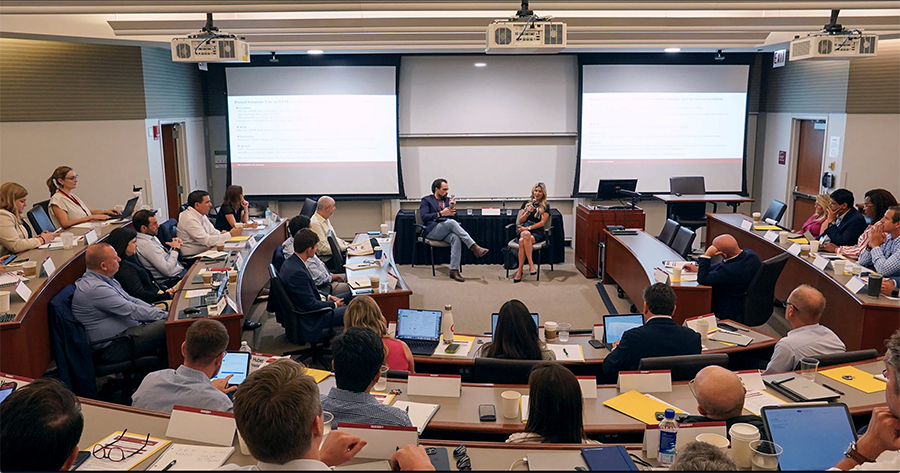
The part of the program Caudill hadn’t anticipated was the community aspect. It continues to this day with UChicago’s CXO in-person events that bring revenue leaders together with executives from AI, HR, and accounting to discuss the recent business developments and how they’re being used. Recently, that focus has been AI. “There’s always someone out there thinking about it differently, using it differently—whether that’s AI or something else brand new—and that’s where I think this course becomes a secret weapon for success, because it keeps challenging how you’re applying things and giving you new inspiration.”
The community went beyond just business problems. CXO weekends have also given Caudill space to connect with other women in C-suite roles. “You’re encountering imposter syndrome too? This is how I've dealt with it, or this is how I'm still dealing with it. Let's be in the weeds together.”
For DTC leaders who might wonder whether a program built around B2B and SaaS frameworks applies to them, Caudill emphasizes that it does. “The same tenets still provide frameworks that are impactful,” she says. The key is showing up ready to apply what you learn. If everything is on the line, as it was for Caudill, all the better.
Don't Just Study the Playbook. Learn to Write Your Own.
Join the Chicago Booth's Chief Revenue Officer (CRO) Program and receive a comprehensive learning experience designed to give you the skills and knowledge needed to outperform again and again.