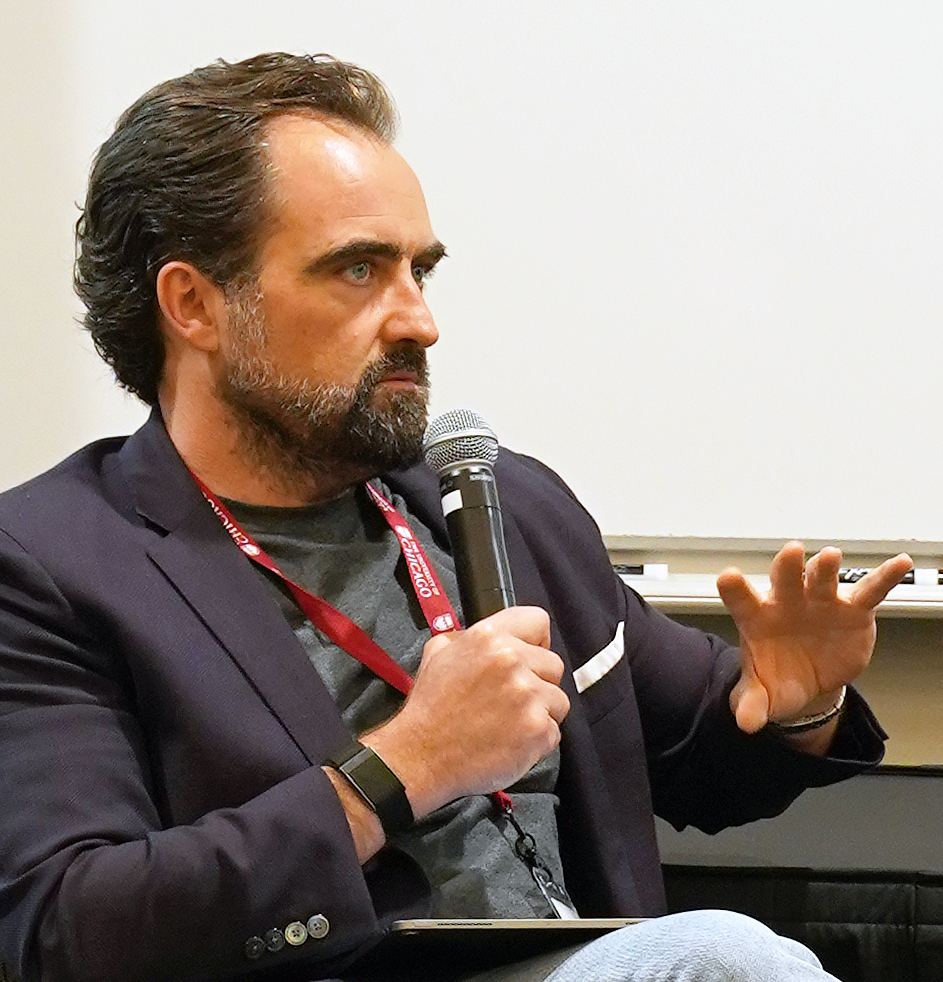
The subscription economy has uprooted traditional ideas about what it means to lead revenue. The old model—a core component to what GTM advisor Emilia D’Anzica calls the “Always Be Closing” era—treated the sale as the finish line. In a world of recurring revenue, by contrast, the sale is just the beginning. “Sales is a tiny fraction of the customer’s journey,” D’Anzica says. “Your job is to get them in the door, but what happens afterward is where the gold is.”
This conviction is central to D’Anzica’s approach to customer life-cycle management, which she teaches in the Chief Revenue Officer (CRO) Program at the University of Chicago’s Booth School of Business. A Silicon Valley veteran, she launched her own consultancy and training academy and later sold both ventures. As a serial fractional Chief Customer Officer, she’s also seen deep into the inner workings of more companies than most executives ever will. It’s the sort of experience that lets her teach both the frameworks CROs rely on and the failure modes these frameworks don’t warn you about.
Not every program has a whole section on what happens after the sale. They just skip over it. They think we’re irrelevant, and that’s a unique differentiator that this program brings to the table.
Emilia D’Anzica, CRO Instructor
For D’Anzica, what distinguishes the Booth CRO program is its recognition that customer life-cycle management needs to be a pillar of any revenue curriculum. “Not every program has a whole section on what happens after the sale,” she says. “They just skip over it. They think we’re irrelevant, and that’s a unique differentiator that this program brings to the table.”
The shift D’Anzica describes relates to the major change in revenue functions that began when software moved from one-time purchases to subscriptions. The trend has since spread far beyond tech. Today, the initial sale is often the smallest piece of a customer’s lifetime value, with expansion, renewal, and referral revenue typically dwarfing it. That means a single bad experience can cancel an entire stream of future revenue and poison every colleague that customers talk to. A great experience turns customers into referral engines potentially carrying your product with them for the rest of their careers.
“Companies and business schools haven’t fully recognized the centrality of customer experience when it comes to repeatable business,” D’Anzica says. “Human interactions matter, especially in six- and seven-figure contracts. It’s very hard to wipe a bad experience out of your mind.”
D’Anzica builds her course with the power of these human interactions in mind. That’s why she centers it around a capstone exercise that puts participants in front of a simulated board. Working in small groups, they present a complete customer life-cycle management strategy and budget in nine minutes while using only two slides. The board—played by D’Anzica and her teaching assistants—then delivers five minutes of pointed feedback.
“If you’re going to be a CRO, you have to be confident when it comes to speaking in public,” she says. “It’s nonnegotiable.” The exercise brings together everything participants learn while also making them develop the executive presence the CRO role requires. D’Anzica notes that, as you move up through sales, you can expect CROs to be skilled at working prospects or rallying a team, but presenting to boards and defending a budget to the C-suite takes a different sort of skill set, language, and even demeanor. It means framing investments in terms of strategic risk, capital efficiency, and portfolio tradeoffs rather than pipeline momentum and deal velocity.
We are hyper-connected through social media and AI, but we are losing the powerful techniques that come with in-person communication. That’s where you persuade and convince people to trust and buy from you. The world we live in today is hyper-lonely and people are more skeptical, often withholding their trust. Hence, communication and emotional intelligence become superpowers.
Emilia D’Anzica, CRO Instructor
This focus on presentation skills is part of D’Anzica’s broader belief that the role of communication in business is changing and that the new landscape calls for deliberate cultivation rather than just hoping these skills develop along the way. “We are hyper-connected through social media and AI,” she says, “but we are losing the powerful techniques that come with in-person communication. That’s where you persuade and convince people to trust and buy from you. The world we live in today is hyper-lonely and people are more skeptical, often withholding their trust. Hence, communication and emotional intelligence become superpowers.”
That attentiveness to the details of human communication and connection also shapes how she thinks about who’s often missing from leadership conversations. With women still underrepresented in C-suite revenue roles, D’Anzica makes a point of reaching out to female participants in the CRO program for one-on-one conversations. “Look, it’s really hard,” she says. “Often, you’re the only woman in the room.”
Her own experience has reinforced how often the basics get overlooked. She’s sat in boardrooms where the buyer was referred to as “he” even when the customer base was majority female. “If you don’t know your persona,” she says, “who are you selling to?”
D’Anzica, who wrote a book on being a tech mom and the exodus of women from the industry during COVID, incorporates these lessons into her teaching. Her course includes a section on persona building that emphasizes understanding the full context of who customers are—their culture, background, and their gender.
In short, for D’Anzica, the program’s deeper lesson is that great CROs orchestrate that full context. They build systems and feedback loops that keep working long after any single deal closes. Participants leave with a tool kit they can use immediately and a global network of peers focused on the same challenges. The gold, as D’Anzica sees it, is there for the taking, especially for those who know where to look.
Real Decisions. Real Tradeoffs. Real Accountability.
Learn valuable information you can immediately use on the job in this evolving C-Suite role while networking with other senior leaders.