
Executive Coaching for Leaders Course
Transform how you lead: build trust, unlock growth, and coach through change with executive leadership coaching grounded in real-world practice.
GET IN TOUCH Customize for Organizations

Upcoming Dates
Course starts
At a Glance
- Enrollment:
- Part-time
- Length:
- 8 weeks
- Format:
- Online
- Investment:
-
$3,500Withdrawal and cancellation
Choose the Coaching Training that Works for You
UChicago Booth's Executive Coaching for Leaders Program offers you options. You can take this focused course, add on a variety of 1:1 coaching packages, or take the coaching packages as standalone options.
The Chicago Booth EMBA coaching team stands out for both depth and rigor. They are certified, well-trained coaches with well over 1,000 hours of executive coaching experience, and work extensively with senior leaders and Chicago Booth Executive MBA participants.
Executive Coaching Course: Develop a confident, coaching-centered leadership style
The Executive Coaching for Leaders course brings you into a focused, high-caliber learning environment where you can step away from day-to-day demands and reflect on how you show up for your team. Alongside experienced executive coaches and a cohort of peers, you’ll experiment with new ways of listening, asking questions, and having the conversations that shape people’s work and careers.
The eight-session, instructor-led course introduces the core principles and practices of coaching for leaders. This highly interactive, experiential program uses real-world leadership scenarios to equip you to lead more effectively by using coaching-based approaches to support growth and career development.
Designed For
This executive leadership coaching course provides a digital credential for mid- to senior-level leaders who want to better support their teams, develop talent, and drive results using research-backed coaching insights and practices.
Learning Objectives
AI-driven transformation, intergenerational teams, and new expectations for growth are making effective leadership more complex than ever. If you’re a leader who cares as much about how you show up as what gets done, this executive leadership coaching course gives you space to step back from the day-to-day, examine your current habits, and practice a coaching approach you can bring back to your team. Guided by experienced executive coaches and a cohort of peers, you’ll learn to turn key moments into opportunities to build trust, develop talent, and move your people and your organization forward.
Some of the skills you will gain:
- Demonstrate and understanding and apply coaching principles in leadership and career development.
- Use coaching to support individuals through transitions, promotions, and role changes.
- Facilitate reflective conversations around values, strengths, and aspirations.
- Build trust and psychological safety for open dialogue.
- Integrate coaching into performance reviews and development planning.
- Coach through uncertainty, resistance, and change.
Approach and Framework:

Person-centered coaching

Positive psychology

Solution-focused approaches

Psychoanalytic perspectives

Career development frameworks

GROW and other coaching conversation models
Program Format Features
- Eight highly interactive sessions that bring you, your peers, and your instructor together to explore real leadership challenges and practice coaching skills.
- Learning with lectures, self-assessments, role-plays, case studies, and peer coaching practice that help you apply coaching tools to your own context.
- Guided support from expert executive leadership coaching instructors who answer questions, offer feedback, and help you translate insights into everyday leadership.
- Course content that aligns with Association for Coaching (AoC), European Mentoring and Coaching Council (EMCC), and International Coach Federation (ICF) competencies.
Course schedule
| Course Start | April 27 |
|---|---|
| Weekly Live Sessions |
Saturdays 10:00–11:30 a.m.
|
Course Sessions
Session Outcomes:
- Describe coaching principles and their application in leadership and career development.
- Define coaching and its role in leadership and career development.
Activities:
- Lecture: Defining coaching fundamentals and the theoretical context of the course.
- Small group discussion: The Coaching mindset in leadership.
- Coaching Practice: Contracting, listening with empathy and effective questioning using leadership self-assessment.
- Group debrief: Reflections, questions and session feedback.
Learning Outcomes:
- Create psychological safety for open dialogue.
- Encourage multiple perspectives and person-centred decision-making.
- Model behaviors that foster a growth mindset and continuous learning.
Activities:
- Discussion: Defining why listening is important and sharing good practice in feedback.
- Practice Developing Psychological Safety: Work in threes to build and develop the coaching relationship.
- Behavior Commitment: Write down one coaching behavior to implement in your leadership role immediately.
- Group debrief: Reflections, questions and session feedback.
Learning Outcomes:
- Explain how coaching strategies promote self-reliance in individuals and teams.
- Apply structured feedback and coaching models in real scenarios.
Activities:
- Coaching Principles Discussion: Explore GROW coaching model.
- Feedback Framework Practice: Practice GROW, and use core coaching skills to guide improvement.
- Group debrief: Reflections, questions and session feedback.
Learning Outcomes:
- Integrate coaching techniques into performance reviews.
- Use coaching to clarify goals and address performance challenges.
- Build trust and psychological safety during performance discussions.
Activities:
- Mini Lecture: Good Practice in integrating coaching into Performance Conversations.
- Practice: Using the GROW model and SBI frameworks conduct a performance conversation using coaching questions (e.g., “What would success look like for you?”).
- Group Reflection: Identify language that promotes accountability without demotivating.
- Group debrief: Reflections, questions and session feedback.
Learning Outcomes:
- Facilitate reflective conversations around values, strengths, and aspirations.
- Apply coaching models to help team members clarify career goals and pathways.
- Create actionable development plans using coaching insights.
Activities:
- Practice Development Conversations in threes.
- Development Plan Workshop: Use GROW model to design a development plan for a fictional employee.
- Peer Review: Share plans and provide constructive feedback.
- Group debrief: Reflections, questions and session feedback.
Learning Outcomes:
- Use coaching to support individuals through career transitions, promotions, and role changes.
- Guide employees in exploring career pathways through reflective dialogue.
- Build psychological safety for open career discussions.
Activities:
- Mini Lecture: Good Practice in integrating coaching into Career Conversations.
- Career Mapping Exercise: In small groups use coaching questions to uncover aspirations and align with organizational opportunities.
- Discussion: How to balance individual goals with business needs.
- Group debrief: Reflections, questions and session feedback.
Learning Outcomes:
- Coach individuals through uncertainty, resistance, and change.
- Apply coaching techniques to build resilience and adaptability.
- Communicate effectively during transitions using coaching principles.
Activities:
- Mini Lecture: Good Practice in coaching through change.
- Change Curve Coaching: Practice coaching conversations for employees experiencing resistance to change.
- Group debrief: Reflections, questions and session feedback.
Learning Outcomes:
- Identify high-potential employees and coach them for future roles.
- Design succession planning frameworks that include coaching support.
- Promote a culture of learning and coaching across teams.
Activities:
- Mini Lecture: Good Practice in talent development.
- Coaching for Talent: Practice coaching conversations to uncover and plan to develop talent.
- Group Brainstorm: Create a mini succession plan for a key role.
- Group debrief: Reflections, questions and session feedback.
Learning Outcomes:
- Demonstrate integrated coaching, feedback, and career conversation skills.
- Provide and receive peer feedback on coaching techniques.
- Develop an action plan to apply coaching in real-world leadership contexts.
Activities:
- Group Discussion: Reflections on coaching practice and questions.
- Integrated Simulation: Conduct a combined feedback + coaching + career conversation with a peer.
- Action Planning: Create a personal plan for applying coaching principles in your role.
- Group debrief: Reflections, questions and session feedback.
Want Deeper, Ongoing Support? Choose an Extended Coaching Package.
Choose an optional 1:1 coaching package that best suits your personal goals.
Executive Coaching for Leaders coaching packages are available in addition to taking the course or as standalone options. These packages provide targeted coaching on goal setting, long-term career planning, and internal mobility, and can help you sustain momentum well beyond the coursework.
You can use these 1:1 coaching sessions to:
- Set and refine SMART goals and a long-term career roadmap.
- Navigate promotions, role changes, and other major transitions.
- Explore internal mobility and talent development opportunities for yourself and your team.
Explore the variety of packages available.
Earn a Credential in Executive Coaching for Leaders
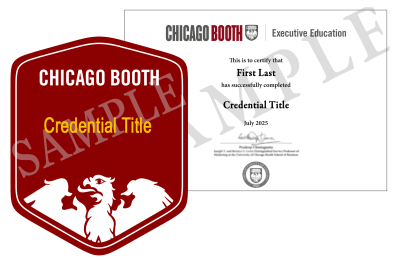
After successful completion of the Executive Coaching for Leaders course, participants receive a credential of completion from the University of Chicago and a digital badge recognizing their achievement in executive leadership coaching.
Executive Coaching for Leaders coaching packages extend and deepen the learning experience but do not grant an additional badge or credential.
Meet Your Course Instructor
Our Executive Coaching for Leaders program is led by an experienced team of executive coaches who work extensively with senior leaders and Chicago Booth Executive MBA participants. In a market where most coaches have only a few hundred hours of experience and training of varying quality, this team stands out for both depth and rigor.
Participants in this program, which includes the coaching course and optional 1:1 coaching packages, have access to a significantly more experienced coaching team than is typically available in the market. The Chicago Booth EMBA coaching team is made up of certified, well-trained coaches with well over 1,000 hours of executive coaching experience. Our lead team member has more than 4,000 coaching hours and a coaching supervision certificate from the Tavistock Centre for Human Relations.
You will also benefit from the strength and reach of the University of Chicago, gaining access to UChicago resources, perspectives, and a powerful professional network.

Chris Lecatsas-Lyus
Executive Coach
Chris Lecatsas-Lyus is a London-based coach/therapist. Chris leads the executive coaching provision for the Sokolov Executive MBA global programme at the University of Chicago Booth School of Business, and is a doctoral candidate on Chester University’s psychological trauma course. Chris has been a...
Special Group Rates
To enroll a group, please contact our admissions team.
How Do I Register for This Course?
- Log into UChicago's course registration portal by creating an account using your username and password.
- Navigate to the Executive Coaching for Leaders course page and click on "Add to Cart" to include it in your course selection.
- Review your course selection and click on "Proceed to Checkout" to complete the registration process.

Ready to Bring Executive Coaching Skills into Your Leadership?
Register today and unite your professional practice with our distinctive blend of academic rigor and real-world application.
ENROLL TODAYOffered by The University of Chicago's Booth School of Business
Of Interest
Executive Coaching for Leaders Program Coaching Packages
Delve deeper with 1:1 coaching sessions that develop crucial leadership skills.